Rewind to when your warehouse team is facing deadline pressure and consider how complicated picking your equipment choice will be. For you as an owner of an industrial unit, operation manager, and purchase manager, picking between manual and electric stackers is an important decision. These machines lift pallets to higher shelving units to optimize vertical space, but one requires human effort while one is automated. Let’s explore all of their pros and cons so you can make a choice that allows your team to operate without unwelcomed issues.
Why Are Stackers A Must In Today’s Warehouses?
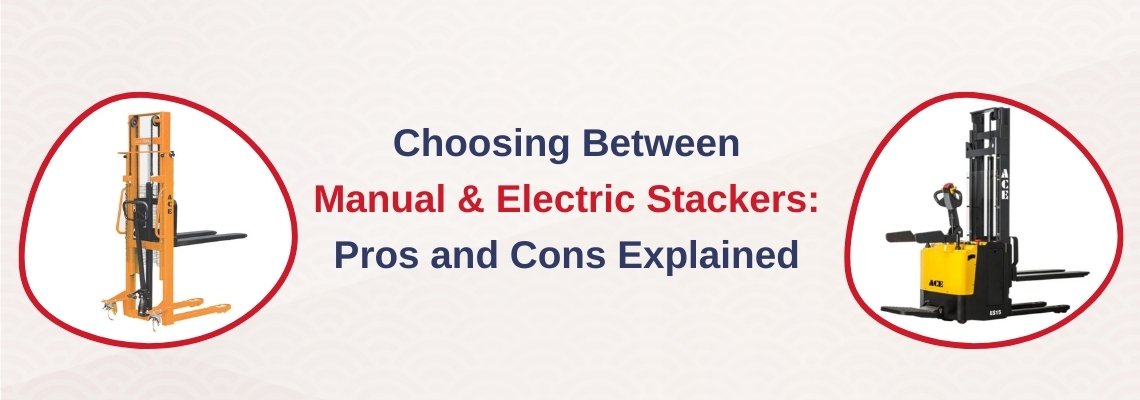
Stackers transform disorganized storage spaces into efficient storage systems by utilizing vertical space to keep products. Manual stackers, which have a basic hand pump, are great for low volume, low frequency tasks. Electric stackers are better for busy days and make the job easier. They effortlessly lift and travel across the warehouse. Your choice will depend on your daily load, daily volume, team size, and your future plans.
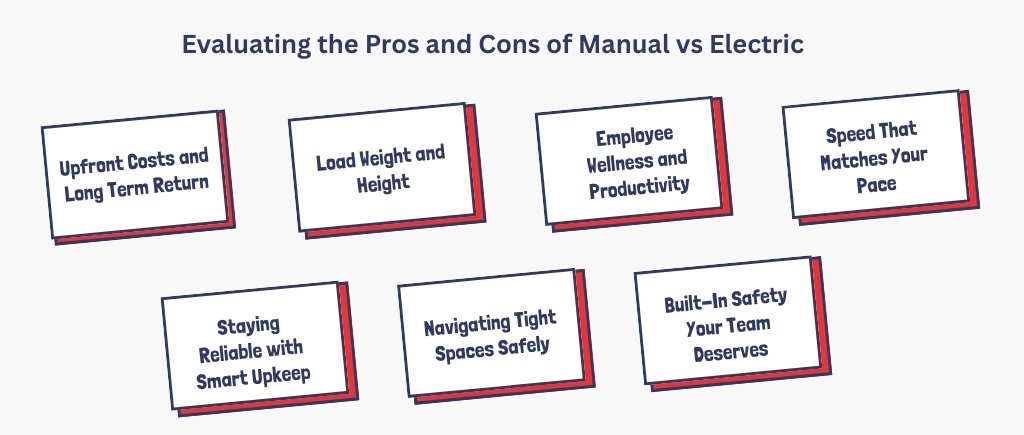
Evaluating the Pros and Cons of Manual vs Electric
-
Upfront Costs and Long Term Return
Starting price points for manual stackers are fairly low, often less than half the cost of their electric competitors, leaving you more room in the budget for other essentials. No batteries means you incur no additional charging costs. However, the additional effort required to operate manual stackers quickly adds up in monthly labour costs. While electric stackers are more expensive, they can be more cost-effective in the long run. Electric stackers complete tasks in a fraction of the time, cutting employee costs significantly.
-
Load Weight and Height
Do you need to stack one ton three meters high? Manual stackers can handle jobs of of one ton, but might overwork themselves on large batches of product. Electric stackers can lift up to and over two tons, and lift to five meters high, perfect for full shelves in multi-level storage. Their reliable high energy does not lessen over time, making height changes smooth and unshaken, and keeping the product from spilling.
-
Employee Wellness and Productivity
Operating a manual stacker for long periods of time is exhausting for the user. Picture a user having to cycle a stacker dozens of times by themselves. An electric stacker is more user friendly. No one is forced to break a sweat. Operating a stacker doesn’t mean they can only move one pallet at a time, doubling pallet movement increases overall productivity. Happy efficiently working employees take less sick leaves and can work for longer periods of time.
-
Speed That Matches Your Pace
Manual handheld units are the most portable option since they don’t need charging. However, they do fall behind during busy times. In those situations, electric units can complete tasks in minutes and increase output by 50% in peak times.
-
Staying Reliable with Smart Upkeep
Manual units can last for years with minimal maintenance, just occasional oiling. Electrically powered units require more maintenance in the form of battery monitoring and motor servicing. However, their sealed construction enables them to complete thousands of uses, and if battery maintenance is executed properly, they will far outlast the manual units in tough use cases.
-
Navigating Tight Spaces Safely
Both the manual and electric units can fit into 120cm wide aisles, but the manual units are less bulky in tight spaces. For slopes and crowds, the electric units have steering assistance and advanced braking systems to help prevent collisions.
-
Built-In Safety Your Team Deserves
Manual units rely on the operator’s familiarity with the units and their steady hands. Electric units include more advanced safety systems, including overload sensors, automatic cutting of the power supply if the unit is tilted, and automatic braking to prevent collisions, all of which significantly improves safety.
Questions to Consider Before Purchase
- How many times do you have to lift each day’s load? Less than 50? More than 100?
- Can you accommodate charging stations, or do you prefer the simplicity of no power?
- Do you have plans for future expansion, or do you plan to remain at the current level?
- What are the floors like? Smooth concrete, or do you have rough patches?
Everyday Myths
Do people think electric ones are always plugged in, they charge overnight, so fully powered for the day, and that’s smart. They complain about the toughness of the manual ones, but the wear on the parts caused by constant pushing is worse.
Warehouse Pro Tips
If you are considering buying manual ones to start, you should switch to electric ones once the order rates go up. A lot of people have a mix of both — one controls an electric for a stack and the other is used for quick picks. Always do a demo in your space to feel the difference.
Your Way to a Smart Decision
Balance your manual and electric stackers to fit your working pattern: manual ones for a light, cheaper start and electric ones for higher speed, more in control, and higher volume. This way you can boost your output while reducing the risk, and make your money more useful.
Join up with local experts, like Manual Stacker India, for more personalized trials and arrangements of your space.